
Tarot Lessons from Magician to Justice

“How will my website, BISONARTZ, unfold?”
That question sounds mystical, but it’s also practical.
A website grows through choices. Some are visible, like the stories published, the pages built, the artwork shared, and the tone chosen. Others happen in private, long before a reader lands on the page. Doubt. Revision. Loss. Pride. False starts. The quiet urge to make something honest anyway.
For BISONARTZ, I don’t see tarot as a fortune-telling tool here. I see it as a mirror. The cards give shape to questions I was already asking.
Why did I build this site?
What did it cost me?
What do I choose next?
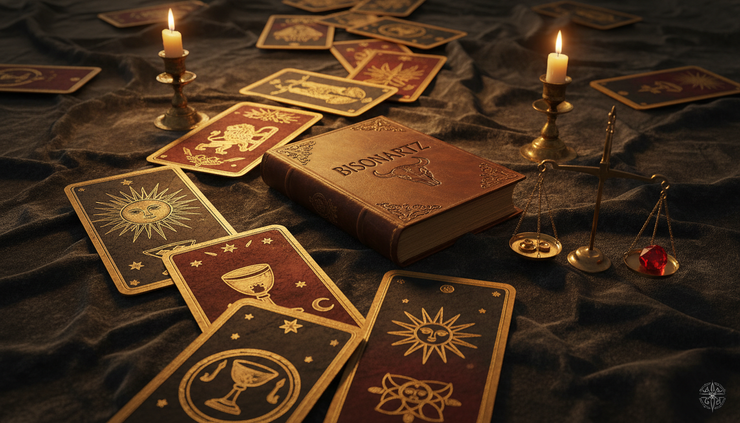
Three cards answer those questions in a way that feels honest: The Magician, The Five of Cups, and Justice.
The Magician holds the spark. The Five of Cups names the grief. Justice asks for a clean choice.
That is the real story of BISONARTZ. It’s autobiographical. It comes from lived experience, not from a borrowed content plan or a polished persona. That matters because people can feel the difference. Readers, authors, presses, publishers, and businesses don’t only look for surface-level writing. They look for a point of view. They look for proof that someone actually stood behind the words.
Google’s people-first guidance says helpful content should be created primarily for people, not search engines. It also points toward first-hand experience, real value, and original insight. BISONARTZ has to live by that rule or it becomes empty.
So this post is not a prediction. It’s a record of becoming.

The Magician began with the need to make something real
The Magician is the card of tools, will, attention, and first movement.
In the tarot image most people recognise, the figure stands with objects laid out before them. A wand, a cup, a sword, and a coin. Each one stands for a different kind of power. Fire. Feeling. Thought. Material life. The message is simple. You already have enough to begin.
That is where BISONARTZ started.
Not with perfect conditions. Not with a finished map. Not with a neat public identity. It started with a need to gather the tools already in reach and make them answer to one purpose.
For me, that purpose was storytelling.
BISONARTZ was never meant to be a blank site filled with flat posts. It was meant to hold a voice. A record. A body of creative work that could speak across several worlds.
It needed to speak to readers who want feeling and clarity.
It needed to speak to authors who understand the labour behind a finished piece.
It needed to speak to presses and publishers who care about point of view, quality, and consistency.
It needed to speak to commercial businesses that don’t want hollow copy, but writing with pulse and memory.
That sounds broad, but the centre is personal. BISONARTZ begins with the belief that original storytelling still matters. Not only because it sounds better, but because it carries evidence of a life.
A personal story can show what generic content can’t.
It can show:
the decision behind the work
the pressure that shaped the voice
the mistake that changed the method
the experience that made the subject matter
the reason the writer came back to the page
The Magician card fits this beginning because building BISONARTZ has always meant turning fragments into form.
A note becomes an essay.
A memory becomes a theme.
An image becomes a direction.
A wound becomes a question.
A question becomes a page.
That doesn’t happen by accident. It takes attention. It takes craft. It takes the nerve to begin before everything is ready.
The Magician also carries a warning. Having tools is not the same as using them well.
A website can have pages, images, categories, and a clear offer, yet still feel dead. A story can have a beginning, middle, and end, yet still feel borrowed. A creative house can have a name, yet still lack an inner law.
So the motivation behind BISONARTZ couldn’t be “I need a website.” That would be too small.
The deeper motivation was this:
I needed a place where the work could stand in its own voice.
Not trimmed into something safer.
Not flattened to match everyone else.
Not written only to please a search box.
A website is a container, but it can also become a witness. BISONARTZ gives my creative life a place to gather. It lets scattered pieces speak to one another. It lets the personal become structured without losing its force.
That is The Magician at work. Not magic as escape. Magic as focused effort.
The card says, “Choose your tools. Name your aim. Begin with what you have.”
That was enough to start.
The Five of Cups named the losses I couldn’t skip
No honest creative project moves from vision to success without spilling something.
The Five of Cups shows a figure standing before fallen cups. Some cups are overturned. Others remain upright, but the figure does not always see them. The card is often read as grief, regret, disappointment, or fixation on what went wrong.
For BISONARTZ, this card doesn’t feel negative. It feels accurate.
Every site has a public face, but the private process can be full of friction.
There were drafts that didn’t hold.
There were ideas that felt urgent at first, then thin the next day.
There were pages that needed to be rebuilt because the voice wasn’t clear enough.
There were moments when I had to ask whether the project was becoming too wide, too personal, too hard to explain.
That last part matters.
Creative work often suffers when we try to make it easy to label too soon. A project can be literary, visual, commercial, autobiographical, and useful at the same time. But when you’re building it, that mix can feel unstable.
BISONARTZ had to pass through that instability.
The Five of Cups teaches that loss is not only failure. Sometimes loss is editing. Sometimes it’s the price of finding the right shape.
I had to let go of versions of the site that were too vague.
I had to let go of pages that sounded polished but didn’t carry enough truth.
I had to let go of the fear that personal writing would be seen as less serious than “professional” writing.
That fear is common, and it’s wrong.
Autobiographical work can be disciplined. It can be useful. It can be carefully made. Personal does not mean loose. Personal does not mean careless. Personal means accountable to lived experience.
That is also where Google’s people-first guidance becomes useful, not as a trick, but as a standard. The guidance asks creators to focus on content that gives people a satisfying experience. It asks whether content shows first-hand knowledge. It warns against making pages mainly to attract visits without offering real value.
That aligns with what BISONARTZ has to become.
A personal site cannot survive on imitation. If the work sounds like it could have been written by anyone, the site loses its reason to exist.
The Five of Cups forced a hard lesson:
Originality is not decoration. It is responsibility.
If I write about building BISONARTZ, I have to tell the truth of the building. Not only the clean part. The doubt belongs in the record. So do the poor starts. So does the pressure to make the site legible to different kinds of people without breaking its inner thread.
This is where the autobiographical nature of BISONARTZ becomes more than a theme. It becomes a method.
The site grows from lived material. That doesn’t mean every private detail belongs online. Boundaries still matter. A good autobiographical piece does not confess everything. It chooses what serves the story, the reader, and the meaning of the work.
There’s a difference between exposure and honesty.
Exposure throws everything onto the page.
Honesty selects the true thing and gives it shape.
BISONARTZ has to choose honesty.
That choice affects every part of the work. The essays. The descriptions. The creative notes. The way projects are introduced. The way the site explains what it offers. The language has to carry a person, not a mask.
The Five of Cups also reminds me not to stare too long at what didn’t work.
Some cups fell. Fine.
Some drafts failed. Fine.
Some pages had to change. Fine.
The remaining cups matter too. They represent the parts of the project that still stand. The voice. The will. The archive. The desire to connect with serious readers and thoughtful collaborators. The proof that the work kept moving.
That is why the card is not only grief. It is recovery.

Justice asks BISONARTZ to choose its structure with care
Justice is not a soft card.
It brings scales, a sword, and the demand for balance. It asks for truth, fairness, cause, effect, and clear judgement. After The Magician’s spark and the Five of Cups’ reckoning, Justice says, “Now decide.”
That is the current stage of BISONARTZ.
The site can’t remain only an emotional beginning. It can’t live forever inside private struggle. It has to become readable, reliable, and fair to the people who arrive there.
That means making choices.
What belongs on the site?
What should stay private?
What kinds of stories carry the strongest purpose?
How can the work serve readers without flattening the autobiography behind it?
How can BISONARTZ speak to authors, presses, publishers, and businesses without sounding like it was made by a committee?
Those questions are practical. They shape the future.
Justice pushes BISONARTZ toward structure, but not cold structure. The goal is not to remove feeling. The goal is to give feeling a strong frame.
A creative house needs rooms.
One room might hold essays.
Another might hold books, art, or projects.
Another might explain services in plain language.
Another might gather notes from the making process.
Each room needs a reason. Each page needs a promise it can keep.
That is the shift I connect with Vision, Reckoning, Structure: The Next Era of BISONARTZ. The vision came first. The reckoning showed what had to be faced. The structure now decides what survives and how it meets the world.
Justice also asks for consistency.
Consistency does not mean repeating the same thing until it goes stale. It means readers can trust the centre of the work. They can move from one page to another and feel the same intelligence behind it.
For BISONARTZ, that centre is personal storytelling with artistic weight.
The site should not chase every possible topic. It should not try to sound like a magazine one day, a sales page the next, and a diary after that. It can hold different forms, but they need a shared spine.
That spine includes:
clean, direct language
first-hand reflection
respect for readers’ time
clear context for each piece
original images, ideas, or angles where possible
a steady link between life, art, and useful meaning
Justice also raises the issue of trust.
If a site makes a claim, it should support it. If it offers a story, it should honour the truth of that story. If it speaks to creative people, it should not reduce creative work to a trick. If it speaks to businesses, it should not pretend that strong writing appears by accident.
Good writing has labour inside it.
Readers may not see every revision, but they feel the result. Publishers know this too. So do presses. So do businesses that have paid for forgettable words and learned the cost of sounding like everyone else.
BISONARTZ has to respect that labour. It has to choose quality over noise.
This is The Magician, the Five of Cups, and Justice: What BISONARTZ Taught Me About Building a Creative House. Start with tools. Face the losses. Build the law that will hold the work.
Justice is also about boundaries.
Autobiographical writing needs them. Without boundaries, the work can become too raw to serve anyone. With too many boundaries, it becomes distant and bloodless. The task is to find the line.
A story can be personal and still shaped.
A memory can be true and still edited.
A hard lesson can be shared without turning into spectacle.
That balance matters because BISONARTZ is not only about me. It begins with my experience, but once published, the work enters a wider space. A reader brings their own life to it. An author brings craft questions. A publisher brings standards. A business brings a need for language that carries trust.
Justice asks the site to meet all of that without betraying its origin.

Personal storytelling is the strongest foundation BISONARTZ has
A website built from personal storytelling has one advantage that can’t be copied cleanly: lived experience.
Someone can copy a format. They can copy a headline style. They can copy the idea of using tarot as a frame. They cannot copy the exact life that made the work necessary.
That is why autobiographical content matters so much here.
BISONARTZ is not only a name. It is a record of decisions, taste, struggle, memory, and creative pressure. The more honestly it draws from those sources, the stronger it becomes.
That does not mean every post has to say “I” in every paragraph. Autobiographical writing can take many forms.
It can appear as:
a direct personal essay
a reflection on a creative process
a note about a finished work
a behind-the-scenes account of a choice
a review shaped by personal standards
a project page that explains why the work exists
The point is not self-display. The point is authorship.
Readers want to know where the voice comes from. Publishers look for control of tone and thought. Presses care about identity, seriousness, and direction. Businesses want words that feel specific enough to be trusted.
Original personal storytelling serves all of those needs because it gives the work a centre.
Google’s people-first guidance supports this direction. It asks creators to produce content that feels helpful and satisfying. It encourages first-hand experience and warns against creating material mainly to perform for search systems. That is not only a web rule. It’s a creative rule too.
When writing starts with the real question, it has energy.
When writing starts with “What can I publish to fill space?”, it weakens fast.
BISONARTZ has to keep asking better questions.
What did this process teach me?
What can this story give someone else?
What did I learn the hard way?
What choice am I making now?
What does this piece reveal about the larger body of work?
Those questions lead to content that has weight. They also protect the site from becoming generic.
For example, a plain page might say, “BISONARTZ creates original writing for creative and commercial needs.” That may be clear, but it doesn’t carry much life.
A stronger version would show the belief behind the work. It might explain that BISONARTZ treats every piece as a meeting point between story, structure, and voice. It might show how a personal essay, a book note, or a business page can all depend on the same skill: finding the language that feels true and holds attention.
That difference matters.
One version informs.
The other version reveals.
Revelation is what makes readers stay.
The danger, of course, is turning every page into a performance of depth. That can feel heavy. BISONARTZ needs restraint. Short sentences. Clear claims. Specific examples. No fog.
Personal does not mean vague.
A clear autobiographical piece might say exactly what happened, what changed, and why it matters now. It doesn’t need to inflate the moment. If a failed draft taught me to simplify the site’s direction, I can say that. If the Five of Cups helped me name disappointment without being ruled by it, I can say that too.
The truth can be simple and still be strong.
Personal storytelling also builds memory. People may forget a list of services. They may forget a neat description. They’re more likely to remember the story of a site that used tarot to name its own stages of becoming.
The Magician brought the will to make.
The Five of Cups brought the grief of revision.
Justice brought the demand for clear choices.
That is a structure people can hold in their minds. It gives BISONARTZ a creation story without pretending the story is finished.
The future of BISONARTZ depends on honest choices
BISONARTZ will unfold through the choices made now.
That is the Justice lesson again. Not fate. Choice.
The future of the site needs three things.
It needs a clear voice.
The voice should be direct, intimate, and exact. It should sound like a person thinking with care, not like a page assembled to fill a gap. That voice can be lyrical when the subject calls for it, but it should never hide behind pretty language.
It needs a strong structure.
Readers should know where to go. Authors and publishers should understand the body of work. Presses should see seriousness and continuity. Businesses should see that the writing can move between art and public use without losing its character.
It needs a living archive.
BISONARTZ should grow as a record, not only as a display. Finished pieces matter, but process matters too. Notes, reflections, lessons, and turning points can help readers see the mind behind the work.
The tarot spread gives the map.
The Magician says, “Make.”
The Five of Cups says, “Learn from what fell.”
Justice says, “Choose with honesty.”
That is not a loose spiritual metaphor. It’s a practical creative framework. It can guide what gets written, what gets removed, what gets revised, and what gets built next.
There is also a larger point here for anyone who cares about publishing, art, or public storytelling.
Original work needs a lived centre.
A site can look complete and still feel empty. It can have proper pages and still lack a reason. BISONARTZ has to avoid that by staying close to its own source.
The autobiographical pieces are not side notes. They are the foundation. They explain why the work exists. They give context to the creative choices. They help a reader understand the person behind the page without needing everything explained at once.
That is how trust forms.
Not through big claims.
Through repeated proof.
A sentence that sounds true.
A story that carries weight.
A page that knows why it exists.
A choice that matches the values already stated.
BISONARTZ will unfold if it keeps doing that.
The first question still stands.
“How will my website, BISONARTZ, unfold?”
It will unfold by making the private work readable.
It will unfold by treating personal history as material, not decoration.
It will unfold by respecting readers enough to offer real stories, clear thought, and useful meaning.
The Magician gave BISONARTZ its beginning. The Five of Cups gave it humility. Justice now asks it to become deliberate.
That is the next era. Not a perfect site. Not a finished self. A creative house built in public, with care, memory, and a steady hand on the scales.


Comments